A continent is slowly splitting in two: the crack extends 3.500 kilometers and opens the way to a new sea
The extensive rift extends through a minimum of ten countries. Researchers suggest that Africa's eastern and western fissures indicate potential openings in various directions.
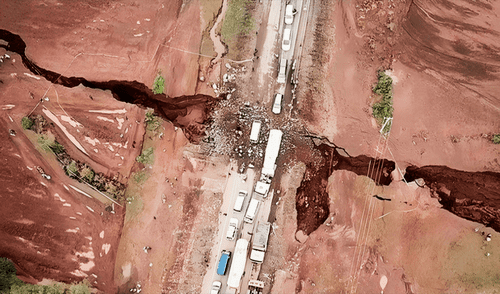
The Earth's surface is in a state of constant motion and change. Around 138 million years ago, South America and Africa were connected. If you observe a globe closely, you'll notice how their coastlines align like puzzle pieces. Similarly, a recent geological process is causing the African continent to split into two.
This rift, identified approximately six years ago, has since been extensively studied to determine its causes and potential impacts. Known as the East African Rift, it stretches 3,500 kilometers from the Red Sea to Mozambique, according to the Geological Society of London.
The East African Rift, extending from the Red Sea to Mozambique, signifies a gradual continental separation, accompanied by seismic and volcanic activity. Image: Clarín
Why Africa is splitting in two?
Thirty-five million years ago, the East African rift started forming. Lucía Pérez Díaz, a researcher specializing in fault dynamics, noted in an article for The Conversation that this rupture is due to a horizontal extension force in the lithosphere. This force caused the Earth's outer layer to stretch, thin, and eventually break, resulting in the formation of the Rift Valley.
- Un hombre que buscaba anillas para paloma con su detector de metales encontró un tesoro de adornos de oro y hachas de cobre de hace 4.000 años
- Florida usa conejos robot que imitan presas reales para atraer a las enormes pitones que invadieron los Everglades
According to the expert, fissures represent the initial phase of a continental breakup and, if successful, can lead to the creation of a new ocean basin. This process is accompanied by other geological phenomena, such as volcanic activity and earthquakes.
She also mentions that beneath the major crack, a substantial column of mantle rises, which continues to weaken and fracture the lithosphere. This occurrence has been documented in geophysical studies and is referred to as the "African superwave".
When will Africa be completely divided?
According to Perez Diaz, it will take several tens of millions of years for Africa to completely split apart.
Cynthia Ebinger, a geology professor, informed Live Science that there are eastern and western fissures throughout Africa, indicating that the continent is splitting in multiple directions.
Ebinger stated that the current rate of splitting is very slow, comparable to the growth of toenails, at approximately 6.35 millimeters per year.
A substantial mantle plume rises and exerts dominance over the lithosphere. Image: Oliver Mearle/Elsevier
However, researchers believe that the rate of splitting could either accelerate or halt, depending on geological forces.
Ken Macdonald, an Earth scientist, explained to LiveScience that it is uncertain whether the splitting will continue at its current rate, eventually forming an ocean basin like the Red Sea, and potentially a smaller version of the Atlantic Ocean. Alternatively, it might speed up or stop altogether.
Regardless, the rift is present and will continue to expand as long as the dynamics of the deep Earth permit it.
Which countries does the African Rift pass through?
The Great Rift spans across the following countries: Mozambique, Malawi, Tanzania, Zambia, Burundi, Rwanda, Uganda, the Democratic Republic of the Congo (DRC), Kenya, and Ethiopia.
NASA and other space agencies have employed an array of satellite platforms and remote sensing techniques to observe and analyze the Rift Valley and its characteristics. Image: Google Earth/The Conversation
Another continent with a fissure
The Himalayan peaks, reaching heights of 8,850 meters above sea level, form the highest mountain range on Earth. This region marks the ongoing collision between the Indian and Eurasian tectonic plates, a process that has been occurring for 600 million years. Geologists have indicated that Tibet, located northwest of these mountains, is at risk of splitting in two.
A study published in the journal Science suggests that the Indian plate is "delaminating" as it moves beneath the Eurasian plate. The friction seems to intensify with each passing century, potentially causing the upper section to break off. Currently, a vertical fissure has been observed.
Lo más visto

Tallarines verdes peruanos: receta clásica deliciosa (VIDEO)

Cómo preparar un arroz con pollo tradicional riquísimo (VIDEO)

Sudado de pescado (VIDEO)

Escabeche de pollo receta: fácil y buenazo (VIDEO)

Paradox Park
Paradox Park: Parque inmersivo donde Roma, Egipto y Grecia cobran vida con juegos, shows, etc
PRECIO
S/ 69.90
Flying Squirrel Parque de Inflables
Flying Squirrel: Full Day, 60 o 120 minutos según elijas en Jockey Plaza, San Miguel e Independencia.
PRECIO
S/ 21.90
Fun Jungle
Fun Jungle: Full Day o 60 minutos según elijas en los Inflables en El Defby y Parque de la Amistad
PRECIO
S/ 28.90
Cineplanet
Cineplanet: 2 Entradas 2D + 2 Bebidas Grandes + Pop corn gigante. Lunes a Domingo
PRECIO
S/ 47.90
Perulandia
Perulandia Full Day + Piscinas + S/. 35 de VALE DE CONSUMO + Perusaurus y más.
PRECIO
S/ 42.90